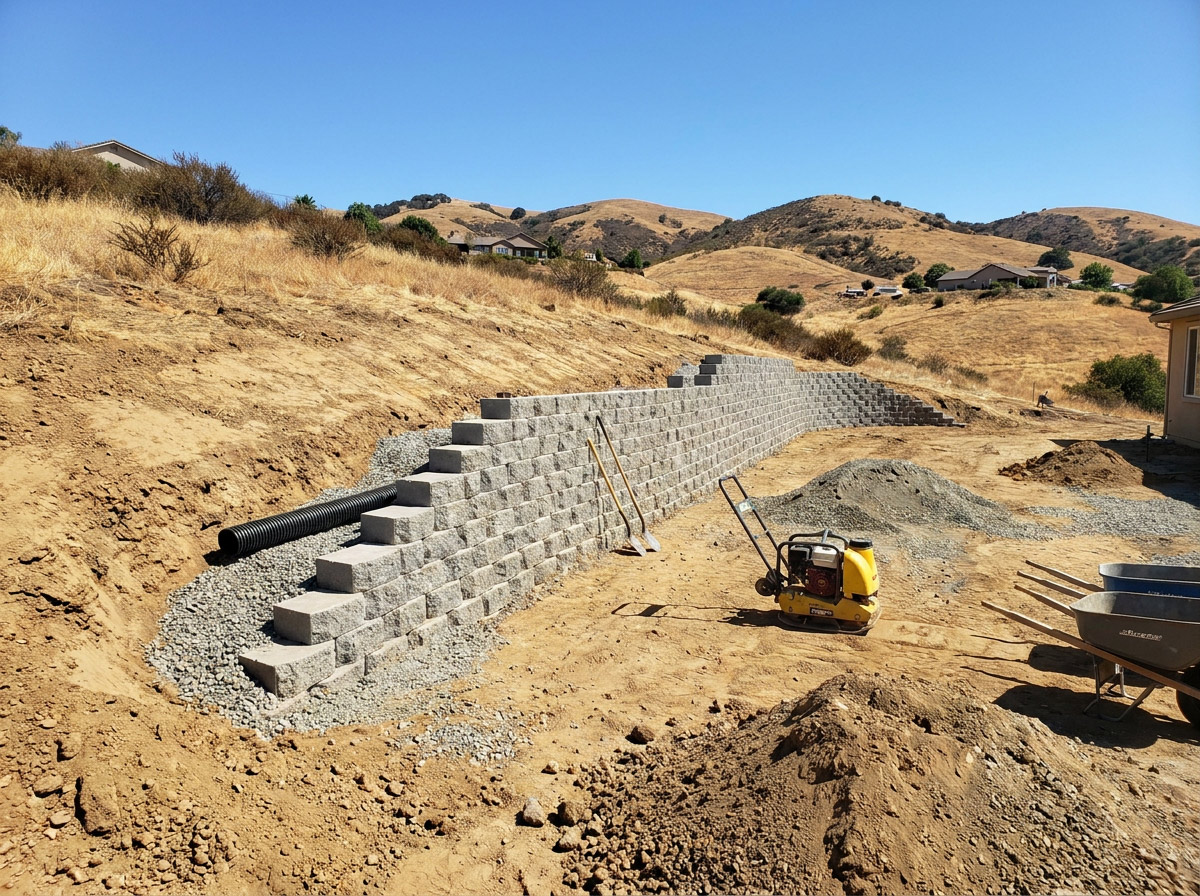
Summer is, on the surface, an appealing time to break ground on a commercial build. The skies are clear, the days are long, rain delays are less frequent, and there’s a natural urgency that comes with getting a project in the ground before fall. If you’re a commercial developer or property owner who’s been circling a build project, the stretch from June through September can feel like an open runway.
And in many respects, it is. Summer construction has real advantages. But the foundation phase — the most consequential phase of any commercial project — has specific vulnerabilities in summer conditions that every owner and developer should understand before they finalize a construction schedule.
Getting foundation timing right in summer isn’t about being cautious for caution’s sake. It’s about protecting the single most expensive and irreversible element of your project.
Here’s what I tell commercial clients when this conversation comes up.
The Foundation Is Not Just the Starting Point — It’s the Permanent Constraint
Before we get into the seasonal specifics, it’s worth grounding ourselves in why the foundation phase deserves more scheduling attention than almost any other part of the project.
Once a commercial foundation is in the ground and cured, every structural decision above it is constrained by it. Column locations, load capacities, slab elevations, utility penetrations, anchor bolt patterns — all of it is fixed at the foundation stage. Errors or quality deficiencies at this phase don’t get corrected during framing or finish work. They get discovered later, often at significant cost, or they quietly undermine the building’s performance over its service life.
That’s why concrete quality during the foundation pour isn’t just a technical detail. It’s the most consequential quality control moment in the entire project.
And concrete quality in summer requires active, deliberate management.
What Heat Does to Concrete — and Why It Matters for Your Foundation
Concrete doesn’t simply “dry.” It cures — a chemical process called hydration, in which water reacts with cement particles to form the crystalline structure that gives concrete its strength. That process is time-sensitive, temperature-sensitive, and moisture-sensitive.
When ambient temperatures are high, several things happen that work against foundation quality:
Accelerated Set Time
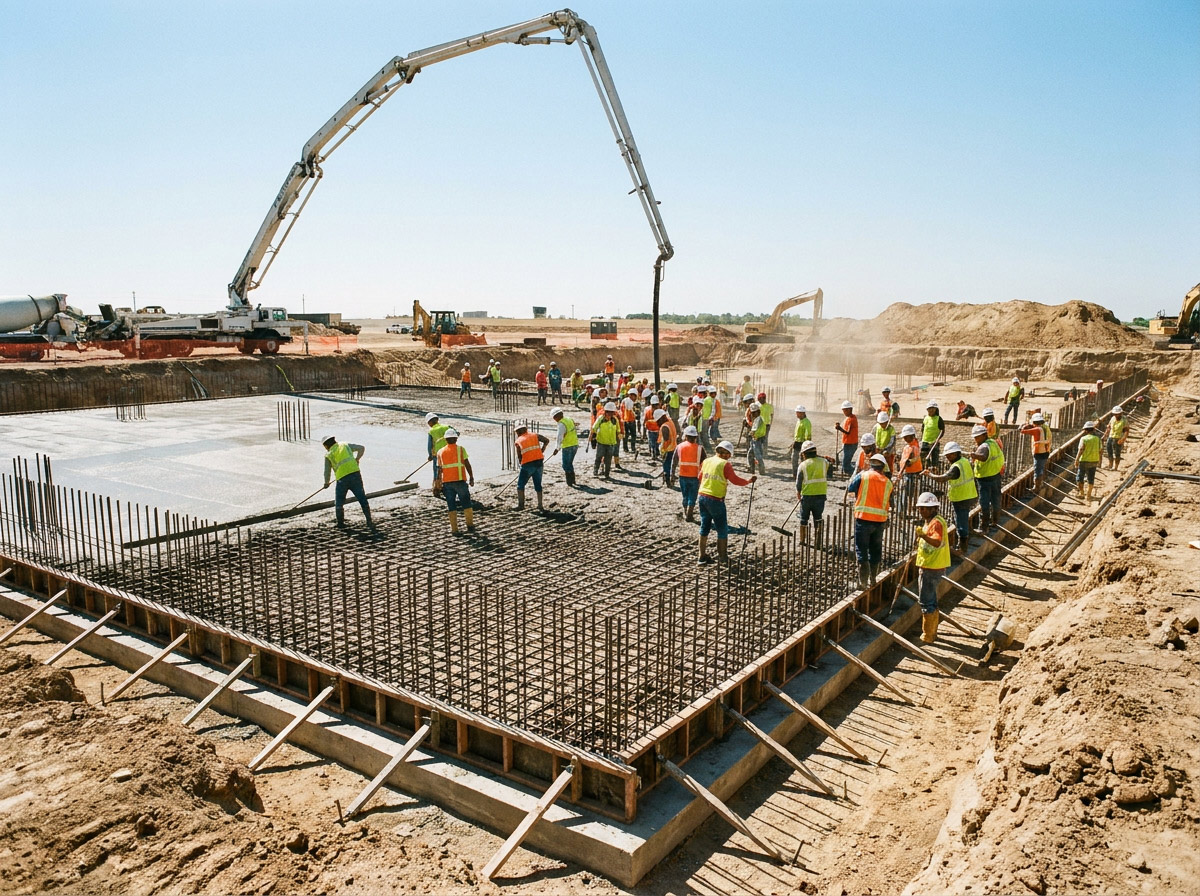
In hot weather, concrete begins to set faster than intended. This shortens the workable window that crews have to place, consolidate, and finish the concrete properly. On a large commercial foundation pour — which may involve thousands of cubic yards of concrete placed continuously over many hours — accelerated set time creates real risk. If sections of a pour begin to set before adjacent sections are placed, you can end up with cold joints: planes of weakness within the foundation where two pours didn’t bond properly.
Cold joints in a commercial foundation are a structural liability. They’re not always visible at the surface, and they may not cause obvious problems immediately — but under load cycling over years, they can become pathways for water infiltration, points of stress concentration, and eventual sources of structural distress.
Reduced Long-Term Strength
Concrete that sets too quickly in high heat may reach its design strength on paper but develop a compromised internal microstructure. The hydration reactions that build long-term strength — which continue for weeks and even months after a pour — are disrupted when the concrete dries out prematurely due to surface evaporation in hot, low-humidity conditions.
Concrete that loses moisture too quickly during its early cure can end up 10 to 20 percent weaker than properly cured concrete of the same mix design. For a residential slab, that margin may be manageable. For a commercial foundation carrying significant structural loads, equipment loads, or multi-story construction above it, that’s a meaningful reduction in the safety margin your structural engineer designed in.
Plastic Shrinkage Cracking
High surface evaporation rates — driven by heat, low humidity, and wind — cause the surface of freshly placed concrete to dry faster than the interior. This differential drying creates tensile stresses at the surface that the fresh concrete doesn’t yet have the strength to resist. The result is plastic shrinkage cracking: a network of shallow surface cracks that form within the first few hours after placement.
On a finished floor slab, these cracks are primarily an aesthetic and maintenance concern. On a foundation wall or grade beam, they can become water infiltration pathways — a significant long-term durability issue on any commercial building.
How Experienced Contractors Manage Hot-Weather Concrete
None of this means summer is the wrong time to pour a commercial foundation. It means summer foundation work requires specific practices that not every contractor applies consistently. When you’re evaluating contractors for your commercial project, the hot-weather concrete management plan is worth asking about directly.
Here’s what sound hot-weather practice looks like:
Mix Design Adjustments
The concrete mix itself can be adjusted to perform better in hot conditions. Common strategies include:
- Reducing the water-to-cement ratio to limit the free water available for rapid evaporation while maintaining workability through plasticizers
- Using a retarding admixture to slow the set time and extend the workable window, offsetting the acceleration caused by heat
- Substituting supplementary cementitious materials such as fly ash or slag for a portion of the cement, which reduces heat of hydration and slows early strength gain in a controlled way
- Chilling the mix water or using ice as part of the mix water to arrive at a lower concrete temperature at the point of placement
These aren’t exotic measures — they’re standard practice for any contractor with commercial foundation experience in warm climates. But they need to be specified in advance, coordinated with the ready-mix supplier, and verified at the point of delivery.
Scheduling Pours to Avoid Peak Heat
On critical foundation pours, experienced contractors schedule placements for early morning or — on very large pours — through the night. Ambient temperatures at 6:00 a.m. are often 15 to 25 degrees lower than peak afternoon temperatures. That difference has a meaningful impact on set time, evaporation rate, and the crew’s ability to manage placement properly.
This has scheduling implications that project managers and owners need to understand. A pour scheduled for “Tuesday” may actually mean a crew arriving on site at 3:00 a.m. Tuesday. That’s not unusual on significant commercial foundation work — it’s the right call.
Pre-Cooling the Subgrade
On large mat foundations or slabs-on-grade, the subgrade itself can absorb and radiate heat, raising the temperature of concrete from the bottom up as it’s placed. Wetting the subgrade before placement — and in some cases, shading it — reduces this thermal contribution and buys additional time in the placement window.
Curing Protocols
Curing is where a lot of summer foundation pours fall short. Once the concrete is placed, the work isn’t done — the concrete needs to retain adequate moisture for the hydration reactions to proceed fully. In summer conditions, that means active curing measures:
- Wet curing (keeping the surface continuously moist with burlap and water or a water misting system) for a minimum of 7 days on critical structural elements
- Curing compounds applied immediately after finishing to seal the surface and slow evaporation
- Polyethylene sheeting over formed surfaces to retain moisture and reduce thermal cycling
Curing is often treated as a detail rather than a priority on active job sites. On a commercial foundation in summer, it deserves the same attention as the pour itself.
Concrete Temperature Monitoring
ACI 305 — the American Concrete Institute’s standard for hot-weather concrete — recommends that concrete not be placed when its temperature exceeds 95°F, and many commercial specifications set that limit lower. Good contractors monitor and document concrete temperature at delivery and at the point of placement. If a load arrives out of specification, it gets rejected. That requires a contractor with the discipline to turn away a concrete truck — a real cost in time and money — when the mix doesn’t meet spec.
Ask your contractor how they handle out-of-spec deliveries. The answer tells you a lot.
Soil Conditions in Summer: The Other Side of the Equation
The concrete quality discussion gets most of the attention in hot-weather foundation work, but soil conditions in summer introduce a separate set of considerations for commercial builds.
Shrinkage and Settlement in Expansive Soils
Many commercial sites in California and other western states sit on expansive clays — soils that swell when wet and shrink when they dry out. Summer, particularly late summer in drought conditions, is when these soils are at their driest and most contracted state.
Founding a commercial structure on expansive soils in their maximum dry-shrinkage state creates a specific risk: when the wet season returns and the soil takes on moisture, it expands. If the foundation wasn’t designed to accommodate that movement — or if the site drainage doesn’t control moisture infiltration — you can get differential heave that stresses the foundation and the structure above it.
This isn’t an argument against summer construction. It’s an argument for making sure your geotechnical report is current, your structural engineer has accounted for soil expansiveness in the foundation design, and the drainage and waterproofing systems that control post-construction moisture behavior are specified and built correctly from the start.
Excavation Stability
Summer-dry conditions affect excavation stability as well. Dry soils can maintain steeper temporary cut slopes than wet soils — which is often an advantage in summer. But certain soil types, particularly silts and loosely cemented sands, can be deceptively stable when dry and collapse rapidly when disturbed or when any moisture is introduced. Understanding the site’s specific soil profile before designing temporary excavation supports is essential regardless of season.
Scheduling Implications for Your Commercial Project Timeline
Understanding the technical requirements of summer foundation work has direct implications for how you structure the overall project schedule. Here are the timeline considerations that commercial owners often don’t account for until they’re in the middle of a project:
Lead time for mix design submittals. If your project requires hot-weather mix design modifications, those need to be submitted, reviewed, and approved by the engineer of record before the pour. That process can take two to four weeks. It can’t happen the day before the scheduled pour date.
Concrete supply constraints. Summer is peak construction season. Ready-mix plants are at high demand, and the early-morning pour windows that minimize heat exposure may have limited truck availability. Coordinating a large commercial foundation pour in July or August — at 4:00 a.m., with chilled mix water, and a retarding admixture — requires advance scheduling with your supplier. Last-minute coordination in summer typically means compromise somewhere.
Curing time is non-negotiable. Structural concrete elements typically require 28-day design strength before significant loading. That timeline doesn’t compress in summer — in fact, poor curing practices in heat can extend the time before elements reach design strength. Build that window into your schedule explicitly, and make sure your contractor isn’t pressuring the schedule past it.
Inspection availability. Municipal inspection departments in summer can be busy and backlogged, particularly in active construction markets. Pre-pour inspections, footing inspections, and slab inspections need to be scheduled with lead time. Missing an inspection window on a commercial foundation can cause multi-day delays.
Questions to Ask Before You Break Ground This Summer
If you’re moving toward a summer groundbreaking on a commercial project, here are the conversations worth having with your contractor before the schedule is locked:
- What is your hot-weather concrete management plan? Ask for specifics on mix design, pour timing, and curing protocol — not a general answer.
- Who is coordinating with the ready-mix supplier on mix design and scheduling? This should have a named person and a documented process.
- What temperature limits trigger a change in approach or a postponement of a pour? A contractor with real hot-weather experience will have a specific answer.
- How is curing being handled, and who is responsible for monitoring it? Curing should appear on the project schedule as a specific activity with a duration, not as an afterthought.
- Has the geotechnical report been reviewed for expansive soil conditions? If the answer is “we’ll check,” that’s the wrong answer at this stage.
- What is the inspection coordination plan? Municipal inspections should be on the schedule with buffer time built in.
The Contractor’s Honest Take
Summer is a good time to build. Long days, dry conditions, and motivated crews make for productive construction seasons. But the foundation phase has real vulnerabilities that summer conditions amplify, and those vulnerabilities are entirely manageable when the project team takes them seriously.
The owners and developers I’ve seen run into trouble with summer foundations almost always have one thing in common: they treated the foundation as a box to check rather than a phase to manage. They picked a pour date based on the schedule, not the conditions. They accepted the first concrete delivery without checking the temperature. They moved on before adequate curing had occurred.
The owners I’ve seen get it right brought their contractor into the schedule conversation early, asked the right questions about hot-weather practices, and treated curing time as a fixed constraint rather than a variable to compress.
The foundation is the one thing in your project you genuinely cannot redo. It deserves the same level of active management as your budget and your lease-up timeline.
Starting a Commercial Build This Summer?
At Saribalis Construction, we plan hot-weather foundation work with the same rigor we bring to every other phase of a commercial project — from mix design coordination and pour timing to curing protocols and inspection scheduling.
If you’re in the planning stages of a commercial build and want to talk through the foundation phase and timing in detail, we’d welcome that conversation. Contact us to schedule a consultation. We’ll give you a straight assessment of what your site and schedule call for — and make sure the most important part of your building gets done right.
Because the best commercial builds start with a foundation that’s built for the long run — not just the summer.