Retaining walls on commercial properties are workhorses. They manage grade changes across parking lots, stabilize slopes behind warehouses and office buildings, define terraced landscaping around retail centers, and protect structures from soil movement. When they’re built right and maintained properly, they perform quietly and reliably for decades.
When they fail, they fail expensively — and often without much warning.
In my years building and repairing retaining walls for commercial clients, the single most common cause of premature failure isn’t the wall material, the block quality, or even the construction method. It’s water. More specifically, it’s what happens to water that gets trapped behind a wall that wasn’t built — or maintained — with adequate drainage.
If you own or manage commercial property with retaining walls on site, this is one of those topics that’s well worth understanding before you have a problem rather than after.
Why Water Is a Retaining Wall’s Worst Enemy
To understand why drainage matters so much, you first need to understand the forces a retaining wall is actually dealing with.
A retaining wall’s primary job is to resist lateral earth pressure — the horizontal force that soil exerts against the wall as it tries to move downhill or outward. That pressure is calculated during design and the wall is built to handle it.
What changes that equation dramatically is water.
When soil behind a retaining wall becomes saturated — after heavy rain, irrigation, or poor surface drainage — two things happen simultaneously:
First, the soil gets much heavier. Saturated soil can weigh 30 to 50 percent more per cubic foot than dry soil. That means the loads pressing against your wall spike significantly every time water accumulates behind it.
Second, hydrostatic pressure builds. Water trapped behind a wall exerts its own independent pressure — hydrostatic pressure — that acts in addition to the soil load. This pressure increases with depth: the deeper the water table behind the wall, the more force it’s pushing against the structure.
A wall designed to handle normal soil loads may be significantly undersized for the combined forces of saturated soil plus hydrostatic pressure. Add enough cycles of saturation and drying — which causes repeated expansion and contraction in the soil — and even well-built walls begin to show stress: leaning, cracking, bulging, or outright collapse.
The solution isn’t to build a heavier wall. The solution is to make sure water never gets the chance to accumulate behind it in the first place.
The Three Components of an Effective Retaining Wall Drainage System
A properly designed retaining wall drainage system works on three levels: it intercepts water before it reaches the wall, it moves water through the backfill quickly, and it gives that water a clear path to exit. Here’s how each component works.
1. Granular Backfill (The Drainage Layer)
The material directly behind a retaining wall — the backfill — plays a critical role in drainage. Native soil, particularly clay-heavy soil common in many commercial sites, retains water and transmits hydrostatic pressure directly to the wall. It is the wrong material to use as backfill for a retaining wall.
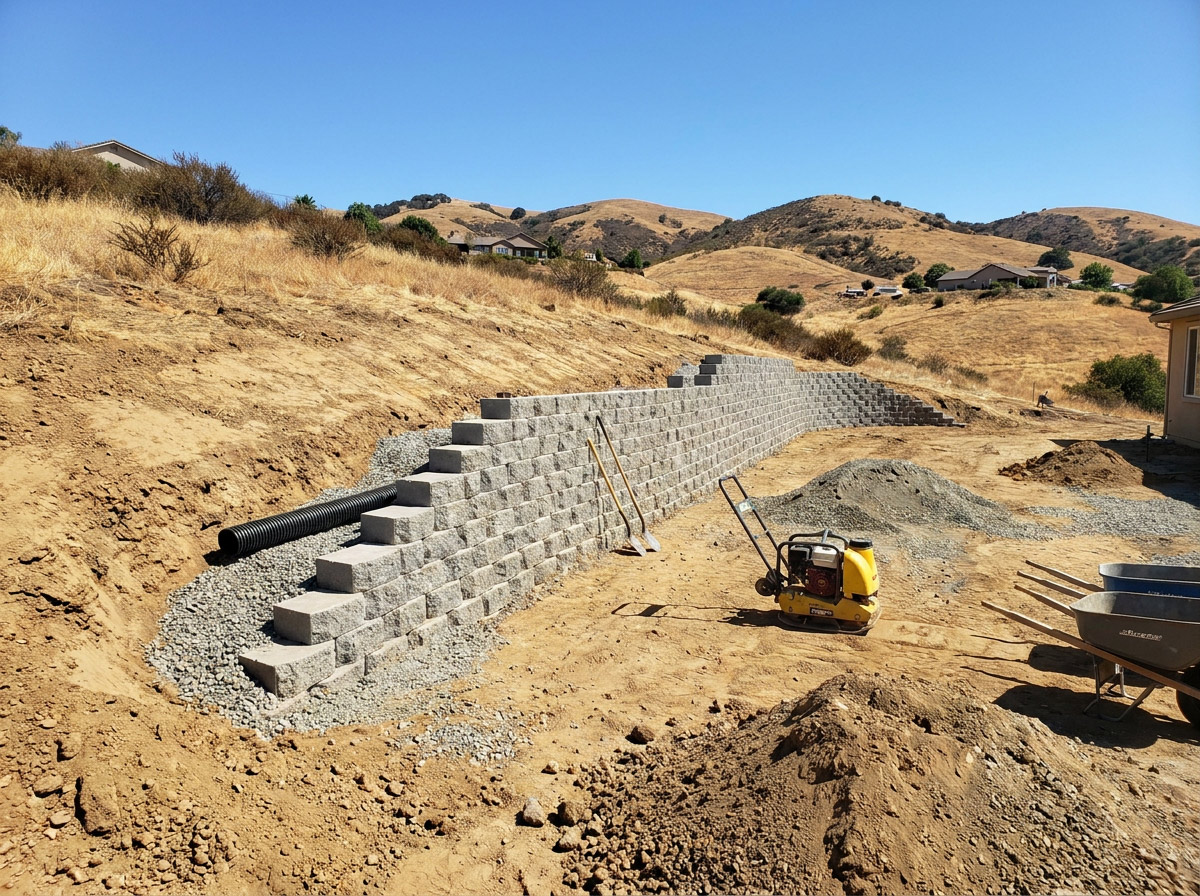
Properly engineered retaining walls use clean granular backfill — crushed stone, gravel, or crushed concrete — in a zone directly behind the wall face. This material has high void content, which means water moves through it quickly rather than pooling. It also has lower cohesion than native soil, which reduces the lateral pressure it exerts when saturated.
The width of the granular backfill zone depends on the wall height, the wall type, and the anticipated water loads — your engineer or contractor will specify this. On a well-built commercial wall, this drainage zone may extend 2 to 4 feet back from the wall face, or more on taller structures.
What goes wrong: Native soil used as backfill, or granular backfill that becomes contaminated over time with fines (silt and clay particles) migrating from the retained soil. Both scenarios reduce drainage capacity and increase lateral pressure.
2. Perforated Drain Pipe (The Collection System)
Even excellent granular backfill can only do so much if water has nowhere to go once it reaches the base of the wall. That’s where the perforated drain pipe — sometimes called a French drain or footing drain — comes in.
This pipe sits at the base of the granular backfill zone, typically at or near the footing level, and collects water that has percolated down through the drainage layer. From there, it carries that water laterally along the base of the wall to a designated discharge point — a storm drain, a daylight outlet at the end of the wall, a detention basin, or other appropriate outlet.
The pipe is typically a 4-inch or 6-inch perforated PVC or corrugated HDPE pipe, wrapped in filter fabric to prevent fines from clogging the perforations over time.
What goes wrong: Drain pipe omitted entirely (surprisingly common on older or lower-budget walls), pipe installed without filter fabric wrapping leading to clogging, or pipe that discharges to a location that causes erosion or pooling near the wall base.
3. Weep Holes (The Pressure Relief Valves)
Weep holes are openings through the wall face, typically spaced 5 to 10 feet apart horizontally and located near the base of the wall. Their job is simple: provide a direct path for water to exit the backfill zone if the primary drainage system becomes overwhelmed or partially blocked.
Think of weep holes as a secondary defense. On a wall with a functioning drain pipe, weep holes may rarely see active flow. But in a heavy rainfall event, or if the primary drain is partially clogged, weep holes prevent catastrophic pressure buildup behind the wall by allowing water to exit directly.
On concrete or masonry walls, weep holes are typically 3-inch diameter openings through the wall face. On segmental retaining walls (the modular concrete block systems common on commercial sites), the open joints between blocks at the base course serve a similar function.
What goes wrong: Weep holes blocked or patched — sometimes by well-meaning maintenance crews who see water coming through and assume it’s a problem to fix rather than a system working as designed. Plugging weep holes is one of the fastest ways to accelerate wall failure.
Surface Drainage: The First Line of Defense
The drainage components built into the wall itself are critical — but they’re the last line of defense, not the first. How water is managed on the surface above and around the wall has just as much impact on long-term performance.
On commercial properties, the key surface drainage principles for retaining wall longevity are:
Grade the retained area away from the wall. The surface behind the wall should slope away from the wall face, directing surface runoff toward catch basins or other collection points rather than concentrating it along the top of the wall. A minimum 2 percent slope away from the wall is a standard target.
Control irrigation. Irrigation systems behind retaining walls are one of the most common sources of chronic over-saturation in commercial landscaping. If irrigation heads are discharging against or immediately behind a retaining wall, you’re essentially running a continuous test of that wall’s drainage capacity. Adjust head placement and run times so irrigation is directed toward plantings, not toward the wall.
Maintain catch basins and inlets. If surface drains near retaining walls are clogged with debris, water that should be intercepted at the surface will instead infiltrate the soil and eventually find its way to the back of the wall. Routine maintenance of surface drainage infrastructure is directly connected to retaining wall performance.
Manage vegetation. Trees and large shrubs behind retaining walls can be problematic in two ways: their roots can penetrate and compromise the wall structure itself, and their canopy can intercept and concentrate rainfall in specific areas. Choose plantings behind commercial retaining walls with both root behavior and water management in mind.
Signs That Drainage Is Failing — What to Look for on Your Property
Even well-built walls can develop drainage problems over time. Here are the warning signs commercial property managers should watch for:
Efflorescence (white mineral deposits) on the wall face. As with foundations, efflorescence on a retaining wall indicates water is moving through the wall material under pressure. It’s not immediately structural, but it signals that hydrostatic pressure is present and drainage may be compromised.
Staining or wet patches on the wall face in areas without weep holes. Water finding its own path through the wall body rather than exiting through designed drainage points.
Weep holes that are dry during or after significant rain events. If water should be coming through weep holes and it isn’t, either the backfill drainage layer is clogged and not conveying water to the weep holes, or the weep holes themselves are blocked.
Soil or fines discharging from weep holes. Water is one thing; if you see soil particles coming through weep holes, the filter fabric around the drain pipe or the drainage layer itself may be failing, allowing fines to migrate and eventually clog the system.
Wall leaning, bulging, or visible crack patterns. Any of these signs indicate that lateral loads on the wall are exceeding its design capacity — a condition that drainage problems accelerate. This warrants immediate structural evaluation.
Settlement or sinkholes in the retained soil area. If soil is disappearing into the drainage system, that’s a sign of internal erosion — a serious condition that can undermine the wall from within.
What Drainage Maintenance Looks Like in Practice
For commercial property owners, retaining wall drainage maintenance is not complicated, but it does need to be consistent. Here’s what a basic maintenance program looks like:
- Annual inspection of the full wall length, looking for the warning signs described above
- Weep hole inspection and clearing — verify openings are unobstructed, particularly after landscape maintenance activities
- Surface drain inspection — confirm catch basins and inlets near the wall are clear and functioning
- Irrigation audit — verify that irrigation is not discharging directly against or immediately behind the wall
- Outlet inspection — confirm that the drain pipe discharge point is clear, not eroded, and not submerged in standing water (which would back up the system)
On larger or more complex commercial walls — tiered systems, walls with significant surcharge loads from parking or equipment, walls retaining slopes greater than 10 feet — a formal annual inspection by a qualified contractor or engineer is worth the investment.
The Cost of Getting It Right Versus Getting It Wrong
Let me put some perspective on this.
A properly designed drainage system — granular backfill, perforated drain pipe, weep holes, and appropriate surface drainage — adds cost to a retaining wall project. On a typical commercial wall, you might be looking at an additional 15 to 25 percent over a wall built without these components.
A retaining wall failure on a commercial property is a different cost conversation entirely. Depending on the scale, you’re looking at emergency stabilization, shoring, demolition of the failed wall, remediation of any damage to adjacent structures or infrastructure, redesign, permitting, and reconstruction. On a significant commercial wall, that can easily reach six figures. And that’s before you factor in liability exposure if the failure affects adjacent tenants, vehicles, or structures.
Proper drainage isn’t a premium upgrade. It’s the baseline for a retaining wall that actually does its job over a normal commercial service life.
What We Look for When We Assess an Existing Commercial Retaining Wall
If you’re unsure about the drainage adequacy of existing retaining walls on your property, an assessment by a qualified contractor can give you a clear picture of where things stand. Here’s what that typically involves:
- Visual inspection of the full wall for structural distress signs
- Review of any available as-built drawings to understand what drainage was designed and installed
- Weep hole and outlet inspection to confirm function
- Assessment of surface drainage conditions and grade
- Review of irrigation systems in the retained area
- Identification of vegetation that may be contributing to moisture loading or root intrusion
From that baseline, we can tell you whether the wall’s drainage is performing as it should, whether maintenance or minor repairs are needed, or whether a more significant intervention is warranted before the next wet season creates a problem.
Protect Your Commercial Property’s Investment
Retaining walls represent a significant capital investment on any commercial site. The drainage system behind them is what makes that investment last.
If you have retaining walls on your property that haven’t been evaluated recently — or if you’ve noticed any of the warning signs described here — we’d welcome the opportunity to take a look. Saribalis Construction works with commercial property owners and managers on retaining wall construction, drainage upgrades, and structural assessment.
Contact us to schedule a site visit. We’ll give you a straightforward assessment and a clear set of recommendations — no pressure, just professional insight you can act on.
Because a retaining wall that manages water properly is a retaining wall that stays standing.