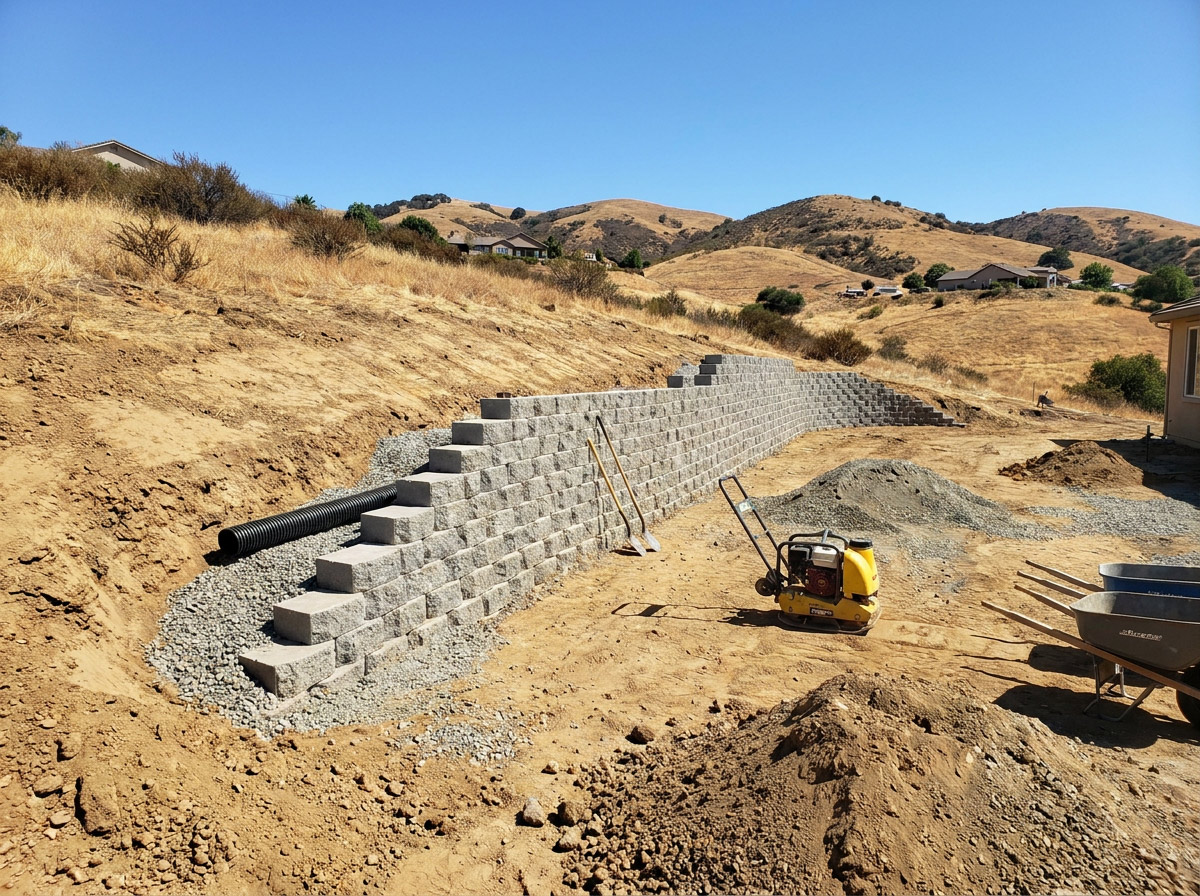
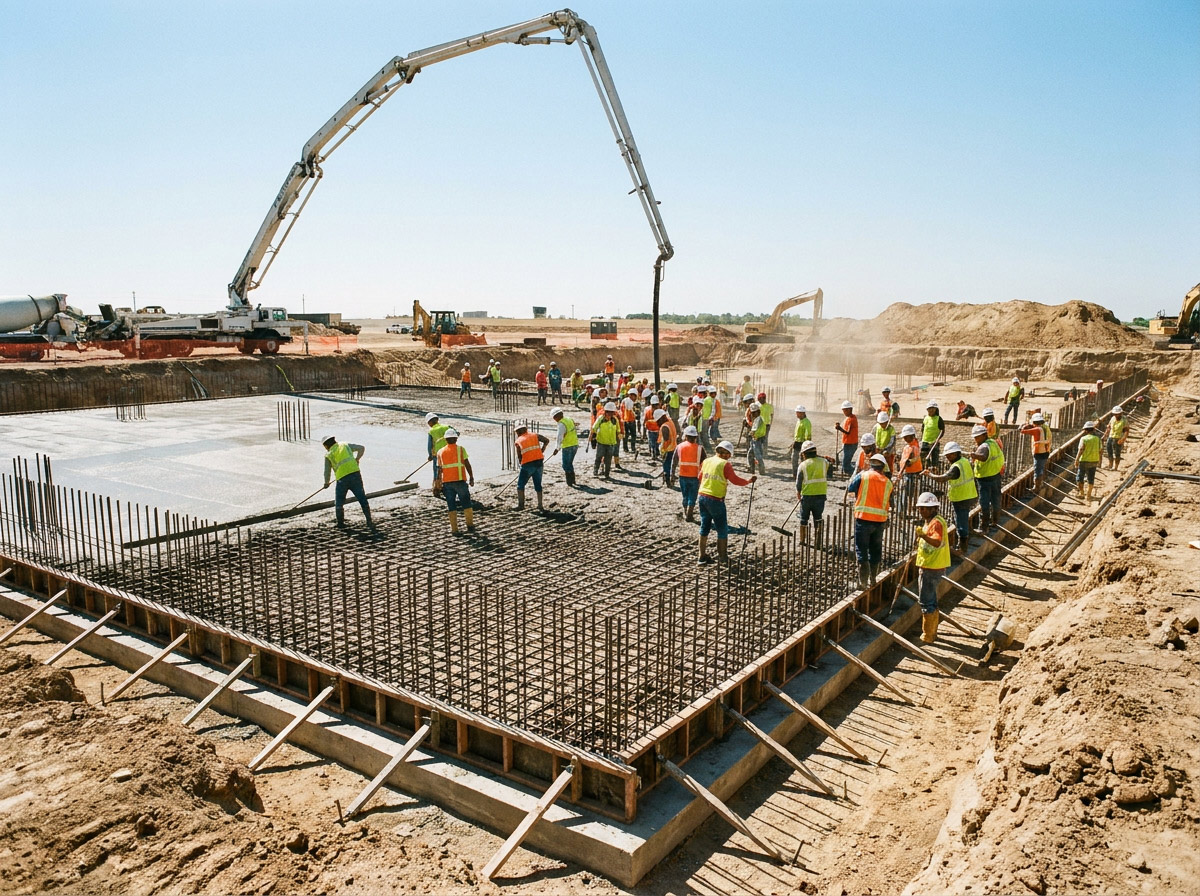
If there’s one piece of advice I give commercial property owners who’ve been putting off a retaining wall project, it’s this: stop waiting for the right time, because the right time is right now.
Summer — from late May through September — is genuinely the best window of the year to design, permit, and build a commercial retaining wall. Not marginally better. Meaningfully better, across nearly every dimension that determines whether a wall project goes smoothly and delivers lasting results.
I’ve built retaining walls in every season, on commercial sites ranging from small parking lot grade separations to large tiered walls supporting multi-acre development pads. The projects that go best — on schedule, on budget, with the highest quality outcomes — consistently happen when construction falls in the summer window. The projects that run into trouble are disproportionately the ones rushed into the ground ahead of the wet season or pushed through in winter conditions.
Here’s why summer makes the difference, and why if a retaining wall is on your capital plan, the time to move is now.
Reason 1: Soil Conditions Are at Their Most Workable
The single biggest variable in retaining wall construction — the one that affects excavation productivity, backfill quality, drainage installation, and ultimately the wall’s long-term performance — is soil condition. And in summer, soil is at its best.
Excavation Is Faster and More Predictable
Dry summer soil cuts cleanly and holds its cut face better than wet or saturated soil. Excavation productivity in dry conditions can be 30 to 50 percent higher than in wet-season conditions, where equipment is fighting mud, cut slopes are sloughing, and water management consumes crew time and equipment capacity. On a large commercial wall with significant excavation requirements, that productivity difference translates directly to schedule and cost.
Dry excavations are also safer. Wet excavations introduce trench instability, equipment traction problems, and dewatering requirements that complicate the work and add cost. In summer, most commercial retaining wall excavations proceed without any of those complications.
Backfill Compaction Reaches Design Density
Granular backfill behind a retaining wall has to be compacted to a specific density — typically 95 percent of maximum dry density per ASTM standards — to perform as the drainage layer and lateral support material it’s designed to be. Achieving that compaction spec requires the backfill material to be at or near its optimum moisture content.
In wet conditions, backfill placed behind a wall is often too wet to compact properly. Crews either wait for it to dry — which takes days and stalls the project — or they compact it wet and accept a substandard result. Either way, the outcome is worse than what summer conditions allow.
In summer, granular backfill at optimum moisture content compacts efficiently and predictably. Compaction tests pass on the first attempt. Work progresses at pace. And the drainage zone behind the wall is installed at the density it was designed for — which is exactly what you want in a system whose performance you’re depending on for 30 or 40 years.
Reason 2: Concrete and Masonry Work Performs Better
Most commercial retaining walls involve concrete in some form — whether a cast-in-place concrete wall, a concrete masonry unit (CMU) block wall, or concrete footings and tie-back elements behind a segmental retaining wall system. Summer’s warm temperatures are a genuine advantage for this work, within the appropriate limits.
Concrete Cures Faster and More Uniformly
Concrete gains strength through the hydration process, and that process proceeds more rapidly in warm temperatures than in cold. A footing poured in summer at 75°F ambient temperature reaches design strength meaningfully faster than the same footing poured in November at 45°F. That faster strength gain means earlier stripping of forms, earlier loading of the footing, and an overall faster pace of work above the foundation level.
For commercial clients working against a schedule — a tenant move-in date, a development milestone, a fiscal year capital spend requirement — the faster curing cycle in summer has real schedule value.
No Cold-Weather Concrete Complications
Cold-weather concrete work below 40°F requires protective measures — insulating blankets, heated enclosures, accelerating admixtures — that add cost and complexity and introduce quality risks if not managed carefully. Fresh concrete that freezes before adequate curing has occurred suffers permanent strength loss; there’s no correcting it after the fact.
Summer eliminates this category of risk entirely. Concrete placed in summer cures without thermal protection requirements, and the primary management focus shifts to hot-weather precautions — earlier pour start times, curing compounds, wet burlap — which are straightforward and well-understood.
Masonry Mortar Sets Properly
For CMU or stone retaining walls, mortar performance is temperature-dependent. Mortar placed in cold weather sets slowly, is vulnerable to freeze damage before it reaches strength, and can debond from masonry units if temperatures drop too sharply after placement. Summer mortar work proceeds at the pace and quality the mix was designed for, with none of those complications.
Reason 3: You’re Building Ahead of the Load
Here’s the framing I use with every commercial client considering a retaining wall project: a retaining wall spends most of its working life managing water. Specifically, it’s managing the hydrostatic pressure and saturated soil loads that build up behind it during the wet season. That’s when a retaining wall earns its keep — or fails.
If you build your wall in summer, it has months to fully cure, backfill to settle and stabilize, and drainage systems to be verified and adjusted before the first significant rainfall event tests them. When the wet season arrives, your wall is a finished, stable, inspected structure. It’s ready.
If you build in fall — or worse, if you rush construction into November because you’ve been delaying the project — the wall may still be under construction or freshly completed when the first major rain event hits. Backfill that hasn’t had time to consolidate, drainage pipe connections that haven’t been verified, concrete that hasn’t reached full design strength. That’s exactly the wrong condition to encounter your first wet season in.
I’ve seen walls built on aggressive fall schedules develop problems in their very first winter that wouldn’t have occurred if the project had been completed in summer. Preventable problems, every one of them.
Reason 4: Permitting Timelines Work in Your Favor
Commercial retaining walls above a certain height — typically 4 feet of retained height or greater, though this varies by jurisdiction — require building permits and often geotechnical and structural engineering. That permitting process takes time: plan preparation, plan check, back-and-forth with the building department, geotechnical peer review in some jurisdictions.
In California and many western markets, permit turnaround times for commercial projects can range from four to twelve weeks depending on the municipality, the complexity of the project, and the department’s current backlog. Fall is historically a busier period for construction permitting as developers try to squeeze projects in before year-end. Summer applications often move faster.
More importantly: if you start the permitting process now, you can have approvals in hand by late summer and complete construction well before the wet season. If you wait until fall to start permitting, you’re looking at a winter construction window — the worst possible scenario for the reasons already discussed — or a delay until next spring.
The lead time math is simple. Start the design and permitting process in summer. Build in summer. Be done before it rains.
Reason 5: Contractor Availability and Project Focus
This is a practical point that commercial clients often overlook: contractor quality and project focus are better in summer than in the compressed fall construction season.
Late fall is when every developer and property owner who deferred their project scrambles to get work done before year-end. Contractor schedules compress, crews are stretched across multiple jobs, material lead times lengthen as demand spikes, and the general quality of attention any individual project receives goes down.
Summer construction — particularly if you schedule your project with reasonable lead time — means your project gets the focused attention it deserves. Crews aren’t being pulled between jobs. Materials are ordered and staged without supply chain pressure. Your project manager has bandwidth to stay on top of quality and schedule.
A retaining wall is not a project where you want a distracted crew. The drainage system installation, backfill compaction, concrete placement, and inspection coordination all benefit from consistent, focused execution. Summer gives you that.
Reason 6: Landscaping and Site Integration Can Be Completed in the Same Season
For commercial properties where the retaining wall is part of a broader site improvement — new parking, terraced common areas, landscape planting, hardscape — summer construction allows you to complete the full scope in a single continuous season.
Landscaping installed behind and around a retaining wall in summer establishes root systems before the wet season, which helps stabilize the retained slope and manage surface runoff. Hardscape elements — concrete paving, unit pavers, drainage swales — can be placed and cured properly in summer conditions. The full site improvement package is deliverable in one mobilization, one permit cycle, and one construction window.
Compare that to a fall wall project followed by a winter dormancy period, followed by spring landscaping — a two-season timeline that adds months to the overall project and creates interim conditions (bare disturbed soil behind a new wall going into its first wet season) that are less than ideal.
What Summer Retaining Wall Construction Looks Like in Practice
To put a concrete sequence to this, here’s what a well-run commercial retaining wall project looks like when it’s planned and executed in the summer window:
May–June: Design and PermittingEngage a contractor and structural/geotechnical engineer. Complete site survey and subsurface investigation. Prepare wall design and drainage plan. Submit for building permit. Order long-lead materials if applicable (deadman tie-back hardware, specialized drainage components, custom concrete forms).
June–July: Permitting Review PeriodRespond to plan check comments. Finalize material specifications and procurement. Confirm contractor schedule and crew assignment.
Late July–August: ConstructionExcavation and footing installation. Wall construction — whether cast-in-place concrete, CMU, or segmental block. Drainage layer and drain pipe installation. Backfill placement and compaction. Required inspections at each phase.
August–September: Site CompletionFinal grading, surface drainage establishment, hardscape if applicable. Landscaping installation behind the wall and on the retained slope. Final inspection and permit closeout.
October onward: First Wet SeasonWall is complete, inspected, and fully stable. Drainage system is confirmed operational. The structure goes into its first wet season as a finished, proven system.
That is a clean project, properly sequenced, with no exposure to the risks that compressed fall or winter timelines create.
The Case for Moving Now
If you have a retaining wall project somewhere on your capital plan — whether it’s a new wall as part of a site development, a replacement of an aging or failing wall, or a drainage and stability upgrade to an existing wall system — the question of when to do it has a clear answer.
The soil conditions are right. The curing conditions are right. The permitting timeline works. The contractor calendar is open. And completing your wall now means it’s proven and ready before the season that will test it most arrives.
Every month of delay past summer narrows your window, increases the likelihood of weather complications during construction, and pushes your wall’s first wet season stress test closer to the day the last inspector signs off.
Ready to Start Your Commercial Retaining Wall Project?
At Saribalis Construction, we specialize in commercial retaining wall design-build — from initial site assessment and engineering coordination through permitting, construction, drainage installation, and site completion. We’ve built walls on commercial sites across the region, and we bring the same attention to drainage design, backfill compaction, and concrete quality to every project regardless of scale.
Contact us now to schedule a site consultation. The sooner we start, the more summer you have to work with.
The best retaining wall is one that’s finished, cured, and draining correctly before the first drop of rain. Let’s build yours.