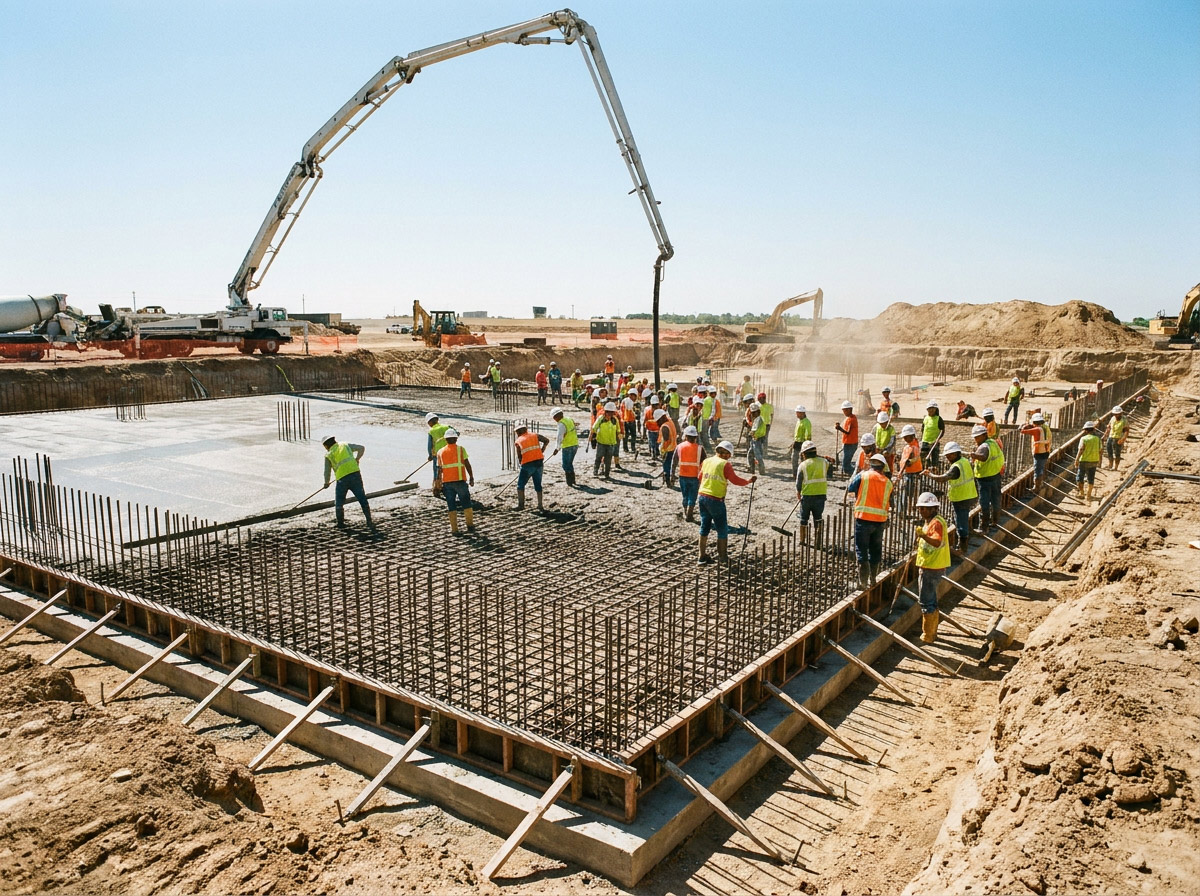
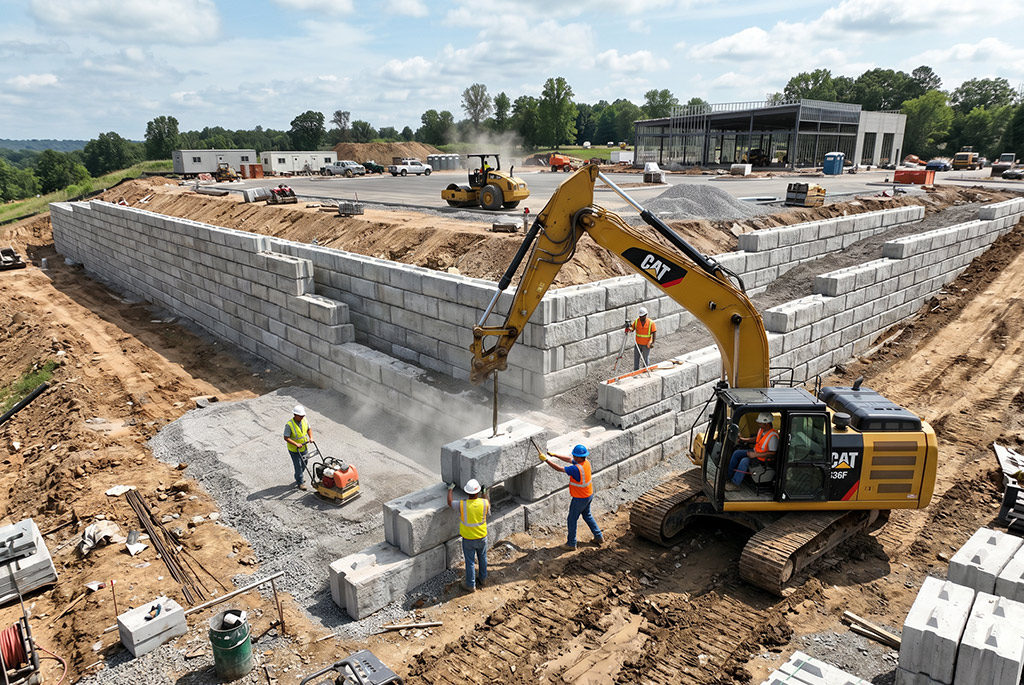
Twenty-five years in the Bay Area, and I still tell every contractor and engineer I work with the same thing: the retaining wall you pour in July is the one that survives February. Summer is our window. Dry ground, stable weather, long daylight — everything a wall needs to go in right. But it’s also the season where a lot of good crews cut corners because the sun’s out and nobody’s thinking about rain. This one’s for the pros. Let’s talk shop.
Why Summer Is Prime Wall Season
You already know the math on this, but it’s worth saying out loud. A retaining wall is only as good as the soil behind it and the base beneath it, and both of those cooperate in summer.
- Dry excavation. You’re cutting into soil that holds its shape. No slumping trench walls, no pumping water out of your footing before you can pour.
- Predictable compaction. Backfill compacts to spec when moisture content is where you want it. Try hitting 90-95% relative compaction on saturated clay in January and you’ll be back out there in spring.
- Concrete and grout cure clean. Warm, stable temps mean predictable set times. Just watch your hot-weather placement — high heat pulls water out fast, so keep it wet and don’t let it flash-cure on you.
- Daylight and dry days. More hours, fewer weather delays, tighter schedules. Summer is when you actually hit your dates.
The trap is treating summer like the finish line. It’s not. It’s the head start. Everything you build now gets tested the first time the hills soak through.
Drainage Is the Whole Ballgame
If you take one thing from this, take this: hydrostatic pressure kills more walls than bad blocks ever will. Water builds up behind a wall, the soil goes saturated and heavy, and that lateral load climbs fast. It’s the leading cause of the leaning, bulging, cracked walls we get called out to replace — and nearly every one of them had a drainage system that was skipped, undersized, or clogged.
Build the drainage in summer like the rain is coming, because it is. Non-negotiables on our jobs:
- Free-draining backfill. Clean gravel against the wall, not native fill dumped back in the trench. Native soil traps water; that’s the opposite of what you want.
- A real drain pipe. Perforated pipe at the base, holes down, wrapped or bedded in gravel, sloped to daylight or a proper outlet. Not a token line — an actual path for water to leave.
- Filter fabric. Keep fines out of your gravel and pipe so the system still works in year ten, not just on the day you backfill.
- Weep holes where the design calls for them, and grading up top that sheds water away from the wall instead of funneling it in.
Do this in dry conditions and you can verify every layer. Wait until the wet season and you’re guessing.
Materials and Engineering — Match the Wall to the Job
Contractors sometimes default to whatever they built last time. The site should pick the wall, not habit.
- Segmental block (SRW): fast, flexible, great for residential slopes and terracing. Mind your setback and geogrid reinforcement schedule on taller runs.
- Poured concrete / CMU with rebar: the workhorse for higher loads, commercial, or anywhere aesthetics and strength both matter.
- Anything over roughly 3-4 feet, or with a surcharge (a driveway, a structure, a slope loading the top) — get it engineered and permitted. Bay Area municipalities will ask, and an engineered wall is the one that doesn’t become a liability. We walk clients through local permitting rather than gambling on it.
Know your soil, too. Expansive clay behaves nothing like sandy fill under load. A geotech report on the bigger jobs is cheap insurance against a callback you can’t fix.
The Mistakes That Come Back to Bite
Here’s what we see most on failed walls — pass this along to your crews:
- No drainage plan. Covered above, and it’s number one for a reason.
- Native soil as backfill. It holds water and adds weight. Use gravel.
- A weak or undersized base. Skimp on the footing or the compacted leveling pad and the whole wall telegraphs it.
- Ignoring the surcharge. That wall is fine until someone parks a truck or builds a patio above it.
- No batter or setback. A dead-vertical gravity wall fights physics. Lean it back into the hill.
Plan Your Summer Slate Now
If you’ve got walls on the board for this year, sequence them for the dry months and get the drainage details locked in the plan — not improvised in the trench. Summer’s the season to build strong; the rainy season is the exam. Build for the exam.
We’ve been doing drilling, shoring, foundation, and retaining wall work across the Bay Area — Sonoma and Napa down to Santa Cruz and Santa Clara — for over 25 years, and we back it with a straight answer and a 100% satisfaction guarantee. If you’re a fellow contractor, architect, or engineer who wants a second set of eyes on a wall or a drainage approach before the rain shows up, reach out. Trade to trade, we’re always happy to talk it through.